MENU

Microedge Instruments provides OEM, custom, and semi-custom data logging solutions for customers whose applications cannot be fully addressed by a standard off-the-shelf product.
Our engineering team works with customers to define, design, and produce customized hardware and software based on specific measurement, communication, mechanical, and system-integration requirements.
Customization projects can range from relatively simple modifications to an existing Microedge product to a complete custom data acquisition or monitoring system.
Depending on the application and project scope, customization may include:
This allows customers to start with proven Microedge technology while adapting the product to the needs of a particular application or system.
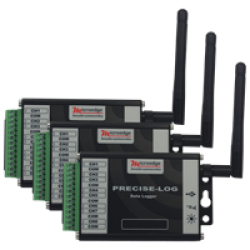
A typical custom data logger can be based on the Microedge multi-channel platform and configured for a combination of measurement types.
A common configuration includes:
The current custom logger platform can be configured with different channel functions according to the application.
Voltage input channels can support measurements up to 20 VDC.
Available ranges may include:
Depending on the design, ranges can be fixed at the factory or made software-selectable so the most appropriate range can be selected in the field.
Current-input channels can support signals up to 50 mA.
Typical configurations include:
Depending on the design, one or multiple ranges can be provided.
Thermistor channels can be configured for compatible resistance-temperature sensors, including commonly used 10 kΩ NTC thermistors.
Custom equations can also be used when a specific thermistor curve or sensor model requires dedicated conversion.
Thermocouple channels can be configured for standard thermocouple types used in industrial and laboratory temperature measurement.
Depending on the design, multiple thermocouple types and programmable input ranges can be supported.
For applications using sensors with standard electrical outputs, Microedge can also review requirements involving:
Suitability depends on the required signal range, resolution, sampling rate, power requirements, and interface.
Custom firmware can be used to adapt logger operation to a specific application.
Possible modifications may include:
For many OEM projects, modifying an existing Microedge firmware platform can reduce development time compared with creating a completely new design.
Because Microedge develops the software used with its data loggers, OEM projects can also include software customization.
Depending on the project, this may include:
This allows the hardware and software to be developed as one integrated system rather than as separate components.
Custom systems can be designed around the communication requirements of the application.
Possible interfaces may include:
The appropriate communication architecture depends on whether the system is intended for standalone logging, local PC access, remote monitoring, industrial integration, or automated data collection.
For higher-volume OEM projects, additional mechanical customization may be available.
The current program states that orders of 100 units or more can provide additional options such as:
For suitable projects, additional options can also be discussed, such as:
These items should be evaluated individually because tooling and engineering requirements vary significantly.
Examples of projects that may benefit from customization include:
A clearer process section would make this page much stronger commercially.
Provide information about:
Microedge reviews the application to determine whether the requirement can be addressed by:
The required hardware, firmware, software, communication, mechanical, and production changes are defined.
For projects requiring engineering changes, a prototype or initial production unit can be evaluated before larger-volume production.
After the design is approved, the product can move into the agreed production quantity and configuration.
To help us evaluate your project efficiently, please provide:
The more complete the initial information, the easier it is to determine whether an existing Microedge platform can be adapted to the application.
Using an existing platform can provide several advantages compared with developing a new logger completely from the ground up:
If your application requires a measurement, communication, software, or mechanical configuration that is not available in a standard Microedge product, contact us to discuss the requirements.
We can review whether the application is best addressed with a standard product, a semi-custom modification, or a dedicated OEM solution.