Tags: in

Remote Temperature Monitoring for Refrigerators, Freezers and Cold Storage

Remote Temperature Monitoring for Refrigerators, Freezers and Cold Storage

MEI 20/10/2026 0
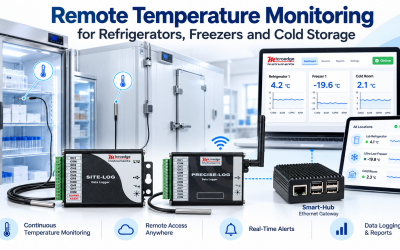
Refrigerators, freezers, cold rooms, and other temperature-controlled storage areas often require continuous temperature monitoring rather than occasional manual checks.By connecting temperature sensors to a Microedge data logger, temperatures can be recorded automatically, viewed in real time, and monitored remotely through a PC or web browser. Alarm thresholds can also be configured to help identify temperatures that move outside the desired range.This Application Note shows several practical ways to build a remote temperature monitoring system using Microedge data loggers and software.  1. Application Typical applications include:RefrigeratorsFreezersWalk-in coolersCold roomsFood storage areasLaboratory refrigeratorsPharmaceutical storageEnvironmental chambersTemperature-controlled warehousesA typical monitoring system consists of:Temperature Sensor → Data Logger → Network → Monitoring Software → Browser / PCThe data logger records temperature continuously while the monitoring software provides access to current and historical data.  2. Choosing the Temperature Sensor The most appropriate sensor depends on the temperature range and installation.ThermocouplesThermocouples are use...
Read More
Remote Tank Level Monitoring Using a 4–20 mA Level Transmitter

Remote Tank Level Monitoring Using a 4–20 mA Level Transmitter

MEI 20/10/2026 0
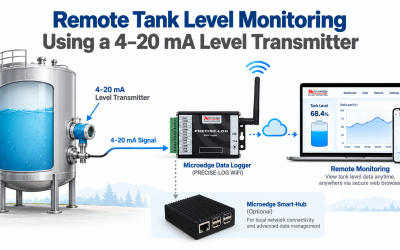
Tank level is commonly measured with pressure, hydrostatic, ultrasonic, or other level transmitters that provide a 4–20 mA output. By connecting the transmitter to a Microedge current-input data logger, the level can be recorded continuously, converted into engineering units, and monitored locally or remotely.This Application Note shows a typical system for monitoring tank level using a 4–20 mA transmitter.  1. Application Consider a storage tank where the liquid level must be monitored continuously.Instead of checking the tank manually, a 4–20 mA level transmitter measures the liquid level and sends the signal to a data logger.A typical system consists of:Level Transmitter → 4–20 mA → Data Logger → PC / Network → Monitoring SoftwareThe system can provide:Continuous level recordingReal-time level displayHistorical graphsEngineering-unit conversionRemote monitoringAlarm monitoring when used with supported software and system configurations  2. Typical Measurement System A common two-wire 4–20 mA transmitter requires an external DC power supply.A typical loop is:24 VDC Power Supply (+) → 4–20 mA Level Transmitter → Microedge Current Input → 24 VDC Power Supply (−)The transmitter cont...
Read More
4–20 mA Sensors and Data Loggers: Wiring, Measurement and Scaling

4–20 mA Sensors and Data Loggers: Wiring, Measurement and Scaling

MEI 20/10/2026 0
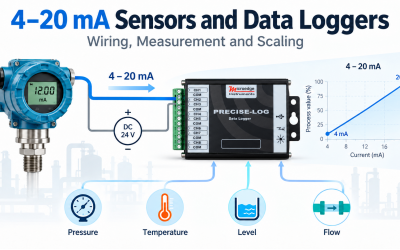
The 4–20 mA current loop is one of the most widely used signal standards in industrial measurement and process monitoring. Pressure, temperature, level, flow, humidity, and many other transmitters commonly provide a 4–20 mA output that can be recorded by a data logger or read by a control system.This Technical Note explains how a 4–20 mA signal works, how it is connected to a data logger, and how the measured current can be converted into meaningful engineering units.  1. What Is a 4–20 mA Signal? A 4–20 mA transmitter converts a physical measurement into an electrical current.Typically:4 mA represents the minimum measurement20 mA represents the maximum measurementFor example, a pressure transmitter with a range of 0–100 PSI may produce:CurrentPressure4 mA0 PSI8 mA25 PSI12 mA50 PSI16 mA75 PSI20 mA100 PSIUnlike a voltage signal, a current-loop signal is generally less affected by voltage drop in long cables, making 4–20 mA widely used in industrial environments.The 4 mA lower limit also provides a useful distinction between a valid minimum reading and certain fault conditions such as an open circuit.  2. Typical 4–20 mA Measurement System A basic 4–20 mA measurement system includes:...
Read More
USB, WiFi, Ethernet, REST API or Modbus TCP: Choosing the Right Data Logger Communication Method

USB, WiFi, Ethernet, REST API or Modbus TCP: Choosing the Right Data Logger Communication Method

MEI 19/10/2026 0
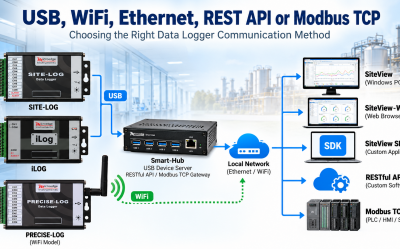
  Modern data loggers can communicate through USB, WiFi, Ethernet, RESTful Web API, and Modbus TCP. These methods serve different purposes, so the best choice depends on how the logger will be used.A simple way to decide is to ask:Is the logger used locally or remotely?Does a person, custom application, or industrial control system need the data?Do you need historical recorded data, real-time readings, or both?  USB: Simple Local Connection USB is the simplest option when the data logger is located near a Windows PC.Typical connection:Data Logger → USB → SiteViewUSB is well suited for:Logger configurationData downloadReal-time monitoringLaboratory testingShort-term experimentsFor many standalone logging applications, USB is all that is required.  Smart-Hub: Put USB Data Loggers on the Network A USB data logger can also be accessed remotely by connecting it to a Microedge Smart-Hub.Typical architecture:USB Data Logger → Smart-Hub → Ethernet NetworkSmart-Hub provides three main functions:USB Device ServerRESTful Web APIModbus TCP GatewayThrough its USB Device Server function, supported loggers can be accessed by:SiteViewSiteView-Web / PlutoSiteView SDKThis allows existing USB-based S...
Read More
Engineering Unit Conversion Made Easy with Microedge's Software

Engineering Unit Conversion Made Easy with Microedge's Software

MEI 25/01/2024 0
In a data logging application, the seamless conversion of input signals from sensors, transmitters, or transducers into accurate engineering units is a critical and fundamental process. Whether dealing with temperature sensors outputting a 4-20mA current signal or determining the dew point from temperature and relative humidity values, our Microedge Data Logging System excels in making these complex conversions effortless.At the core of our software and system are Custom Equations—source code functions written in C# programming language that empower you to generate any engineering unit of your choice. Let's take the example of a temperature sensor:This equation generates temperature value (0-100 Celsius) from 4-20mA current value.Within 'MyTemperature' function, you have the flexibility to integrate any C# source code, tailored to your sensor's specifications, to convert the 'Input' value into the desired engineering unit.For more intricate calculations, our system allows the use of multiple functions for a more organized approach. Consider the equation for calculating dew point:In this equation, 'Channels[0]' holds the temperature reading, and 'Channels[1]' contains the relative h...
Read More
Data Logger Applications in Cold-Chain Industry

Data Logger Applications in Cold-Chain Industry

MEI 07/01/2024 0
Data Logger Applications in Cold-Chain IndustryIn our dynamic and fast-paced world, the cold-chain industry stands as a cornerstone, guaranteeing the secure transportation and storage of temperature-sensitive goods. Data loggers emerge as indispensable tools within this industry, playing a pivotal role in offering crucial insights and safeguarding the integrity of temperature-sensitive products across the entire supply chain.Let's delve into a detailed exploration of the indispensable role played by data loggers in the cold-chain industry.Ensuring Product Quality:In the cold-chain industry, maintaining specific temperature conditions is paramount to preserving the quality, efficacy, and safety of temperature-sensitive products. Data loggers continuously monitor and record temperature variations during transportation, storage, and handling, ensuring that products such as pharmaceuticals, biotechnological materials, and perishable foods remain within the specified temperature range.Compliance with Regulatory Standards:Stringent regulatory standards govern the transportation and storage of temperature-sensitive goods, particularly in industries like pharmaceuticals and biotechnology. ...

Read More
Product Release - SiteView-Web

Product Release - SiteView-Web

MEI 30/10/2020 0
We are pleased to announce the launch of our new product - SiteView-Web, the webserver software for multiple operating systems!SiteView-Web is web server software that can run under most popular operating systems including Windows, Linux and macOS. It can accommodate data loggers and USB device servers that Microedge produces and bring them on-line.You no longer need to take any data loggers back to the office for downloading. The system will download data automatically. If there are any readings beyond the alarm thresholds, the system will email out the alarm notifications.No software is needed to view what happens to your field or chamber. Just open a web browser from your smartphone, tablet or laptop to view the complete system. ...
Read More
Product Relase - Pluto

Product Relase - Pluto

MEI 30/10/2020 0
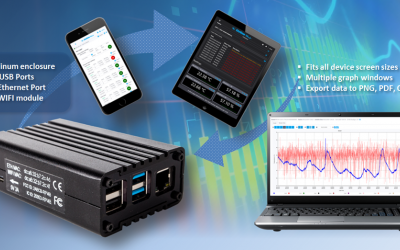
We are pleased to announce the launch of our new product - Pluto, the webserver hardware!Pluto is a Web Server hardware box providing a data logging system that can be accessed remotely from web browsers.Adding a data logger to the system is as simple as plugging it into one of the four on-board USB ports or creating connections to bring other remote data loggers to the system.  Besides the pre-defined pages for device view, graph view, real-time view etc., Pluto allows adding unlimited custom web pages from which you can easily drag & drop user controls on, such as real-time reading, alarm status, label etc.Just plug Pluto into your Ethernet port and enjoy viewing and managing the system from your web browser. If you don’t have a cable network, no problem, Pluto has a WIFI module that can be used to connect to your local network wirelessly. ...
Read More
Temperature Monitoring in Concrete Maturity

Temperature Monitoring in Concrete Maturity

MEI 26/05/2018 0
Concrete maturity indicates how far curing has progressed. Maturity is the relationship between concrete temperature, time, and strength gain. It is represented by an index value that can be measured in real time in the field. The maturity method, often simply referred to as maturity, is a way of evaluating new concrete’s in-place strength by relating time and temperature measurements to actual strength values.To expedite schedules, increase safety, and improve construction methods, construction teams want to know the strength of their concrete at the job site in real time. Since maturity is related to concrete strength, the maturity method is a way to accomplish this without solely relying on standard test specimens and laboratory testing.Maturity is calculated by tracking changes in fresh concrete temperature over time. Since each concrete mix has its own strength-maturity relationship, we can use maturity to estimate the strength of that mix at any moment after placement. When we know the maturity of a certain concrete, we can use that concrete’s specific strength-maturity relationship.When using the maturity method, construction teams can estimate real-time strength gain of in-...
Read More